Commonwealth v. Arnett, No. 19 MAP 2023 | Decided March 26, 2026
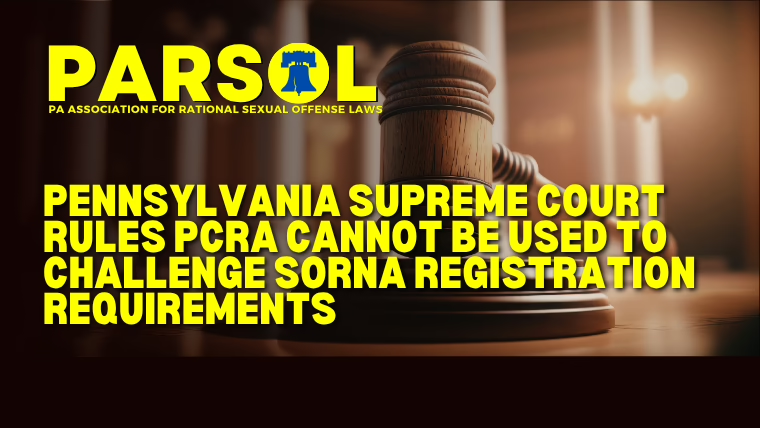
The Pennsylvania Supreme Court issued a significant procedural ruling on March 26, 2026, in Commonwealth v. Arnett, clarifying that the Post Conviction Relief Act (PCRA) is not an available vehicle for challenging the constitutionality of Pennsylvania’s Sex Offender Registration and Notification Act (SORNA II). The decision was authored by Justice Wecht and joined by Chief Justice Todd and Justices Donohue, Dougherty, Mundy, and McCaffery. Justice Brobson filed a concurring and dissenting opinion.
Background
Robert Arnett pleaded guilty in 2004 to aggravated indecent assault and related offenses arising from conduct in 2003. He was sentenced to five to ten years of incarceration and became subject to lifetime registration requirements under the sexual offender registration statutes then in effect. Following his release, the applicable law evolved through multiple iterations — from Megan’s Law to SORNA and ultimately to SORNA II — but his lifetime registration obligation remained intact under Subchapter I, which governs offenders whose triggering offenses occurred before December 20, 2012.
In August 2020, more than fifteen years after his judgment of sentence became final, Arnett filed a pro se PCRA petition. Through appointed counsel, he filed an amended petition arguing that SORNA II’s irrebuttable presumption — that all sex offenders pose a high risk of reoffending — unconstitutionally infringed upon his fundamental right to reputation under Article I, Section 1 of the Pennsylvania Constitution. The PCRA court agreed and granted the petition. The Commonwealth appealed, and the case was ultimately transferred to the Supreme Court.
The Court’s Holding: PCRA Is the Wrong Mechanism
The central holding of Arnett is straightforward but consequential: the PCRA cannot be used to challenge the constitutionality of SORNA II’s registration requirements.
The Court grounded this conclusion in two related points. First, the PCRA’s stated purpose is to provide relief to persons convicted of crimes they did not commit and persons serving illegal sentences. A challenge to SORNA II does not implicate either purpose. A successful constitutional challenge to the registration scheme would not disturb the underlying conviction or alter the criminal sentence — it would only affect a collateral, non-punitive regulatory obligation.
Second, the PCRA’s eligibility requirements reinforce this conclusion. To seek PCRA relief, a petitioner must be currently serving a sentence of imprisonment, probation, or parole. But SORNA II obligations typically begin upon release from prison and can persist for decades — often for life. The Court observed that the “vast majority of registration obligations will persist long after an offender completes his or her sentence, at which point the offender is no longer eligible to seek PCRA relief.” This is not a population the General Assembly intended to serve when enacting the PCRA.
The Court also pointed to the PCRA’s cognizability requirement: claims must relate to the petitioner’s “conviction or sentence.” Because both Lacombe (2020) and Torsilieri II (2024) established that SORNA II is non-punitive and does not constitute criminal punishment, a challenge to SORNA II registration terms is simply not cognizable under the PCRA.
The Merits: Torsilieri II Controls
Having resolved the procedural question, the Court turned to the merits — specifically, the effect of its 2024 decision in Commonwealth v. Torsilieri on the PCRA court’s ruling. The Court held that Torsilieri II controls and requires vacating the lower court’s order.
In Torsilieri II, the Supreme Court upheld the irrebuttable presumption embedded in Subchapter H of SORNA II — the presumption that People Required to Register (PRRs) pose a high risk of reoffending — after finding that expert testimony confirmed adult PRRs reoffend at a rate at least three times higher than individuals convicted of non-sexual offenses. Arnett argued that Torsilieri II should not apply to his case because Subchapter I (which applies retroactively to pre-2012 offenders) differs meaningfully from Subchapter H, particularly given that Subchapter I offenders tend to be older and further removed from their crimes.
The Court rejected this argument. While acknowledging certain differences between the subchapters — including that Subchapter I has somewhat less stringent in-person reporting requirements — the Court found those differences irrelevant to the constitutional question. Both subchapters rest on the same legislative presumption, expressed in nearly identical statutory language. Because Torsilieri II upheld that presumption, and because Arnett presented no evidence at the PCRA hearing to distinguish his circumstances or challenge the presumption’s applicability to Subchapter I offenders specifically, the lower court erred in ruling Subchapter I unconstitutional.
What Remains Open: Habeas Corpus
The Court declined to dismiss Arnett’s petition with prejudice. Because his amended petition was styled as both a PCRA petition and a petition for a writ of habeas corpus, the habeas corpus component survives. However, consistent with its approach in Lacombe, the Court explicitly declined to decide whether habeas corpus is a viable mechanism for challenging SORNA II, noting that the issue was not fully briefed by the parties and that the historical availability of habeas corpus — traditionally limited to those in custody or facing the possibility of custody — presents genuine complexity in the SORNA context.
Justice Brobson’s concurrence and dissent would have gone further: he agreed the PCRA was unavailable, but would have ruled immediately that habeas corpus is likewise not available and that the lower court lacked subject matter jurisdiction. The majority declined to follow that path, citing its commitment to the restrained approach adopted in Lacombe and the importance of allowing the issue to be fully developed with adversarial briefing.
Practical Implications for Registrants and Practitioners
Arnett has several important practical takeaways:
- The PCRA is closed as a vehicle for SORNA challenges. Practitioners representing registrants seeking to challenge their obligations under SORNA II should not file PCRA petitions. The Court has now definitively resolved this question.
- Alternative mechanisms remain unsettled. The Court has not yet determined what procedural vehicle is available. Habeas corpus, a petition for a writ of mandamus in Commonwealth Court, or other mechanisms may be available, but that question is reserved for future litigation with full briefing.
- The irrebuttable presumption challenge is an uphill battle. Following Torsilieri II, any challenge to SORNA II’s core legislative presumption faces a “heavy burden.” A challenger must establish a scientific consensus — not merely expert disagreement — that PRRs pose no greater recidivism risk than other groups. The existing record does not support that showing.
- As-applied challenges may still be available in theory, but the Court signaled skepticism where a petitioner relies on group-level statistical arguments rather than individualized evidence. Arnett’s petition, the Court noted, offered no evidence specific to his personal circumstances.
Commonwealth v. Arnett brings important procedural clarity to a long-unsettled area of Pennsylvania law. After three decades of litigation over Megan’s Law and SORNA in various forms, the Supreme Court has now definitively ruled that the PCRA is not the appropriate mechanism for challenging registration statutes. The ruling does not leave registrants without recourse — but it does require that future challenges be brought through properly developed, alternative procedural vehicles. PARSOL will continue to monitor developments in this area as the courts work toward establishing what those vehicles are.