On August 27, 2026, the Pennsylvania Superior Court issued a published opinion in Commonwealth v. Shapiro, 2026 PA Super 188. The court held that people required to register (PRRs) cannot challenge SORNA’s “high risk” presumption by presenting evidence of their own low risk of reoffending. This closes off a strategy some had hoped to use to escape Subchapter H registration.…
Read MoreCategory: Legal/Court
Supreme Court of PA Settles Mandatory Three-Year Probation Ambiguity
Commonwealth v. Osman, 81 MAP 2024 (Pa. July 21, 2026) On July 21, 2026, the Pennsylvania Supreme Court held that a person convicted of multiple Tier I and Tier II offenses in a single case cannot be sentenced to the mandatory three-year consecutive probation term under 42 Pa.C.S. § 9718.5(a). The decision was 5-2. Justice Donohue wrote the majority opinion.…
Read MorePennsylvania Supreme Court Rules PCRA Cannot Be Used to Challenge SORNA Registration Requirements
Commonwealth v. Arnett, No. 19 MAP 2023 | Decided March 26, 2026 The Pennsylvania Supreme Court issued a significant procedural ruling on March 26, 2026, in Commonwealth v. Arnett, clarifying that the Post Conviction Relief Act (PCRA) is not an available vehicle for challenging the constitutionality of Pennsylvania’s Sex Offender Registration and Notification Act (SORNA II). The decision was authored…
Read MoreCommonwealth v. Kurtz: A Turning Point for Digital Privacy in Pennsylvania
Background of the Case In July 2016, a woman in rural Northumberland County was kidnapped from her home, sexually assaulted, and later released. The victim was unable to identify her attacker, and DNA evidence initially produced no match, leaving investigators without a suspect after traditional leads were exhausted. Investigators then sought a reverse keyword search warrant directed to Google, requiring…
Read MorePARSOL Applauds Third Circuit Victory Protecting Fair Chance Hiring in Pennsylvania
The Pennsylvania Association for Rational Sexual Offense Laws (PARSOL) celebrates a major legal victory for workers with criminal records following yesterday’s decision by the U.S. Court of Appeals for the Third Circuit in Phath v. Central Transport LLC. The court reversed the district court’s dismissal and held that Pennsylvania’s Criminal History Record Information Act (CHRIA) protects job applicants even when…
Read MoreTwo New PA Supreme Court Opinions
Commonwealth v. Kurtz The Pennsylvania Supreme Court’s decision in Commonwealth v. Kurtz, 98, 99, 100 MAP 2023, marks a significant shift in how digital privacy is treated under Pennsylvania law. The Court held that individuals have no reasonable expectation of privacy in ordinary, unprotected Google search queries or related IP-address data. Because the Court found no privacy interest at stake,…
Read MorePA Judge: Registry Internet ID Provision Vague
NOTE: This article and its contents apply only to the case mentioned, not to anyone with same or similar situations. Please do not apply the court’s ruling to your individual case without an attorney or court instructions in writing. [Armstrong County, PA] On Dec. 3, 2025, Judge James J. Panchik of the Court of Common Pleas of Armstrong County, ruled…
Read MorePa. Supreme Court Hears Oral Argument in Commonwealth v. Osman
On October 8, 2025, the Supreme Court of Pennsylvania (SCOPA) heard oral argument in Commonwealth v. Osman, a case that could significantly affect individuals convicted of sexual offenses in the Commonwealth. At issue is a deceptively simple question with major ramifications: Does the law require courts to impose an automatic three-year consecutive probation sentence when a person is convicted of…
Read MorePARSOL Capitol Rally Event Invitation – 10.28.2025 – 2pm
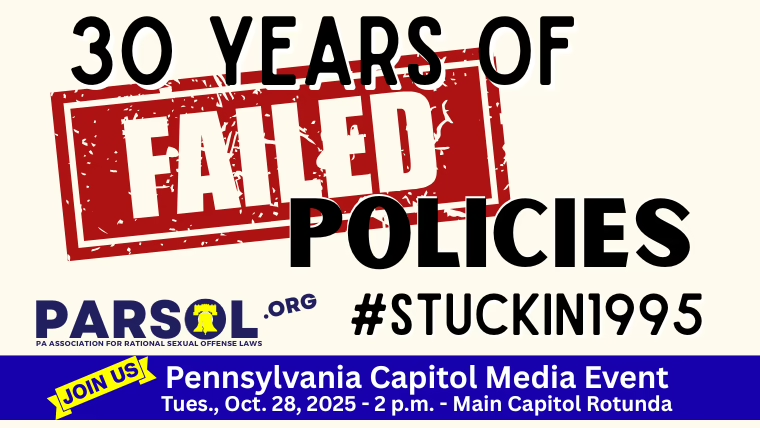
This year marks the 30th anniversary of Pennsylvania’s registry. Thirty years. That’s three decades of a policy born in the “tough-on-crime” panic of the 1990s, still alive today despite overwhelming evidence that it doesn’t make communities safer. As a PRR, I know what it means to live under a system that has barely changed since its inception. At its core,…
Read MoreU.S. Sentencing Commission Releases 2025 Amendments
Today the U.S. Sentencing Commission released its 2025 amendments to the Federal Sentencing Guidelines. The amendments will take effect in 6 months unless Congress overrides them. ACTION NEEDED:USSC is seeking comment on retroactivity of the amendments. Comment Deadline: June 2 ANALYSIS: The below analysis uses the term “sex offender” in direct quote reference to the USSC’s language in the guidelines…
Read More