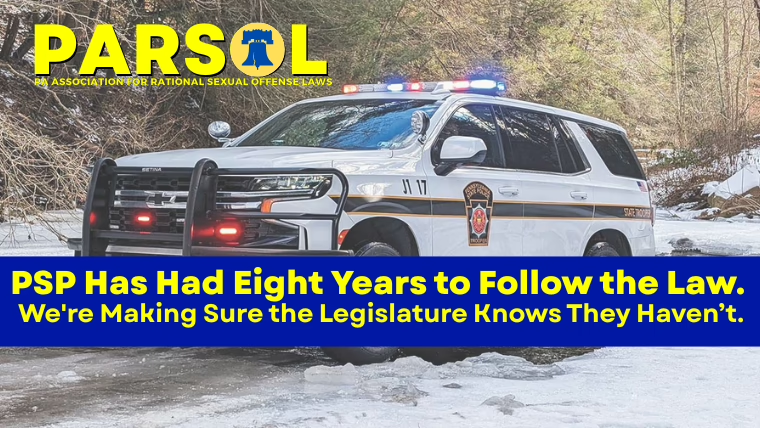
This week, PARSOL transmitted a formal policy memorandum to PA House Judiciary Committee leadership in advance of the upcoming Pennsylvania State Police budget hearings. The memo documents something that should concern every Pennsylvanian who cares about government accountability: the PSP has failed — for eight years — to reliably implement a program it was required by law to build.
We’re not talking about a complicated, discretionary policy initiative. We’re talking about a telephone.
What Act 10 of 2018 Requires
In 2018, the Pennsylvania General Assembly passed Act 10, which amended Megan’s Law to allow individuals who had maintained full compliance with registration requirements for three consecutive years to complete most of their verification appearances by telephone rather than in person. The law required the PSP to develop and operate this system, and specified that it couldn’t go live until the PSP published formal notice in the Pennsylvania Bulletin.
Meanwhile, the PSP has implemented an internet-based web form registration for those under a different subchapter of the same law. Why all individuals required to register cannot use this system is unclear.
That notice finally appeared on June 3, 2023 — five years after the law was enacted.
What has happened since then is the subject of our memo.
A Year of Runaround
Beginning in January 2025, PARSOL began making straightforward inquiries to the PSP’s Megan’s Law Division about the telephonic registration system: Was it working? How did eligible registrants access it? What were the procedures?
What followed was more than a year of deflection, bureaucratic buck-passing, and troubling real-world failures:
- When we asked a PSP corporal about implementation status, we were told — nearly seven years after the law’s enactment — only that they were “aware of the statute.”
- When we pressed further, we were directed to file a Right-to-Know request.
- When the Right-to-Know response finally arrived, PSP told us the request was outside the scope of the law and sent us somewhere else.
- When a PARSOL staff member called the designated telephonic registration number in April 2025, the person who answered said they were “unable to process any telephonic registrations” because they hadn’t received procedures on how to do so — more than two years after PSP announced the system was operational.
- In November 2025, a PARSOL member tried to use the system and was turned away without explanation. PSP staff didn’t answer the phone at all after two-plus minutes of ringing.
- In January 2026, a PARSOL member was told the PSP was manually “reviewing every registrant” and it would “take years” to get to everyone. When that same member appeared in person and asked about telephone registration, state troopers denied that any such process existed.
Why This Matters Beyond Inconvenience
This isn’t just a story about poor customer service. There are real legal stakes here.
Under Pennsylvania law, failure to comply with registration requirements is a criminal offense under 18 Pa.C.S. § 4915.1. That means individuals who were legally entitled to register by phone — but were turned away, given a non-working number, or actively told the system didn’t exist — could theoretically face arrest and prosecution for a violation that was entirely the PSP’s fault.
The statute also requires PSP to send advance written notice to registrants that includes the telephone number for telephonic registration. To our knowledge, this is still not consistently reflected in the notices registrants receive.
Questions We’re Asking Legislators to Raise
Our memo includes an executive summary designed specifically for use in budget hearing questioning. We’re asking legislators to press the PSP on five specific points:
- Why has an eight-year-old statutory mandate still not been reliably implemented?
- Why should the legislature fund new PSP programs when existing ones can’t be executed?
- What accountability mechanisms exist to prevent this from happening again?
- Why were PSP’s own registration staff unaware of a system that had been “operational” for over two years?
- What criminal liability has the Commonwealth incurred by prosecuting or threatening to prosecute individuals for failing to use a system PSP couldn’t operate?
Budget hearings are one of the legislature’s most powerful oversight tools. We believe these are exactly the kinds of questions that belong on the record.
What We’re Asking For
PARSOL is calling on the General Assembly to:
- Demand a full accounting of the telephonic registration system’s current operational status and capacity.
- Require PSP to update all registrant reminder notices and the Megan’s Law website with telephonic registration information, eligibility criteria, and instructions.
- Ensure no individual faces criminal consequences for failing to use a system that the PSP itself cannot consistently administer.
We’re also raising several unresolved legal questions that have practical consequences for registrants right now — including whether a registrant who calls within three business days after their designated date is technically in compliance under the statute’s plain language, and how individuals who register by phone can obtain any verifiable proof of their compliance.
What Citizens on the Registry Should Do
Unless you hear otherwise in writing, until the PSP completely fulfills its obligation to implement the telephonic registration system, you should register in person per your requirements.
Read the Full Memo
The full policy memorandum — including a detailed timeline of events, the outstanding policy and legal questions, and the complete operative statutory text — is available for download below.
[Download: PARSOL Policy Memorandum — Telephonic Registration Under Act 10 of 2018 (March 2026)]
PARSOL is the Pennsylvania Association for Rational Sexual Offense Laws. We advocate for evidence-based, constitutionally sound sex offense policy in Pennsylvania. To support our work or get involved, visit parsol.org.