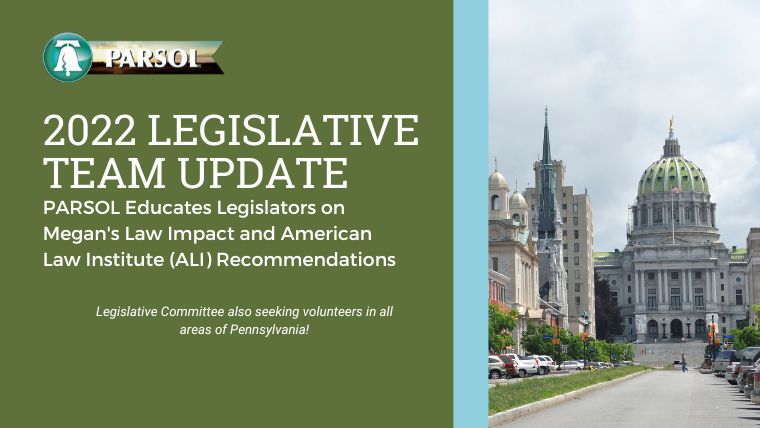
The Legislative Committee of PARSOL is based in Harrisburg but is active across the entire Commonwealth. It is dedicated to forming relationships with our elected officials and tracking bills that affect sexual offense policy.
PARSOL’s sexual offense policy interests include:
- Proactive measures such as education and identifying effective interventions aimed at preventing abuse.
- Criminal Justice Reform (CJR) efforts that might impact conditions of parole/probation, access to programming and rehabilitation while in confinement, sentencing guidelines, mandatory minimums, clean slate, etc.
- Opposing reactive measures that affect people with sexual offenses (for instance, implementing residency restrictions or adding new crimes to the list of convictions that require public registration).
The Legislative Committee’s aim is to bring available research to the awareness of all stakeholders, but especially our State Senators and Representatives.
We also help inform legislators about the latest research around education, community engagement, and mental health issues. When proposed legislation is based on research that is contradictory to the fair and rational treatment of persons with sexual offenses, we argue against them.
During Summer 2022, our Legislative team members met with members of the PA House Judiciary Committee to advocate for best practices around sexual offense policy. They continue to share PARSOL’s belief that PA has taken an ineffective approach by focusing the public’s attention on people listed on the registry. Of particular news is ongoing developments in the Chester County Court of Common Pleas regarding the constitutionality of Pennsylvania’s Megan’s Law.
The main “ask” of these legislators has been the implementation of the American Law Institute’s recommendations from earlier this year. If implemented, these recommendations would:
- End the practice of public sex offense registries, restricting registry information to law enforcement and legitimate background checks
- Clearly defined annual re-registration
- Fixed registration period of 15 years with automatic release after 10 years if all requirements are met and there is no re-offense
- Set clearly defined ramifications for the misuse of registry information up to and including felony offense
- Limit registration categories including removal of minors from the list with some exceptions
- Provide clear rules for petition for relief (defined as a petition not an appeal)
Because we believe that at least some parts of the public registry will be deemed unconstitutional by the Supreme Court of PA, PARSOL feels the time is right to start educating about these issues to rank and file Members of the General Assembly. Our legislators need to know that our current approach is failing to minimize harm, and SORNA is causing hardships for thousands of people across our state.
We’re pretty sure they will be pushed to implement a new version of the registry as a result, so now is the time to teach them about what works well and what does more damage to persons forced to register and society as a whole.
The Legislative Committee is working closely with the PARSOL Education and Legal team to maintain a singular message: Rational sexual offense policy promotes a Pennsylvania that is safe and just for all.
We are actively seeking volunteers to assist in letter-writing, research / bill tracking, and lobbying at the Capitol. If you have skills or interest and want to get involved, please sign up to volunteer.
Last Updated: 09-22-2022



![PARSOL Board Chair Josiah Krammes speaks at the PA Capitol Rotunda flanked by State Reps. Emily Kinkead and Tim Briggs (28 Oct 2025) [John Dawe/PARSOL]](https://parsol.org/wp-content/uploads/2025/10/stuckIn1995_rally_header.avif "stuckIn1995_rally_header - PARSOL - Pennsylvania Assoc for Rational Sex Offense Laws (PA Megan's Law Resources)")
Hello:
I have been trying to find a contact email address but was unable.
Please ask the Parsol Leadership to review this.
Thank you.
Hello:
Recently I attended the Safe and Just Michigan You Tube conference (here: https://www.youtube.com/watch?v=FQUJR9X-kvM&lc=Ugx0cLYEQhkLzN9yop14AaABAg.99FWLQX0tGs99NJTJsXUVj&feature=em-comments )
I wrote a suggestion in the comments section calling on all Floridians to read a brief (10-15 second long) statement to the registering officer every time, immediately prior to registration.
I was asked by Judith Levine (a national advocate who was on the panel) to please present this idea for consideration.
I feel that this must be a national mandate. For, if we are silent, then we give our tacit consent.
I present this conversation to you, our leaders in this epic constitutional fight, for your consideration and contemplation.
Here is the text of the statement, which I am recommending:
” Before we begin, it is my duty to read the following short statement:
I fully intend to comply with Florida (or whatever state) law and to provide you with all of the information that you demand during this interrogation.
However, I am both a Florida and US citizen who currently is under no criminal sanction whatsoever.
As a representative of the government, you have no right to any of my personal information.
You are about to violate several of my rights under the United States constitution. And I object .”
One more thing that I would ask you to consider. Although it may seem to be no more than a ritual to speak the Pledge of Allegiance to the United States Flag, there is a good reason for it!
And, maybe there is a good reason for us to adopt a “pledge of liberty”, as it were. We should tell them that they are violating our rights and that it will not be forgotten.
Thanks for your advocacy and for paying attention, Jeff.
How has this gone in your practice?
In PA, the hope is that very few of us will have to publicly register following the state Supreme Court Decision.