Advocacy organization says video of House Appropriations exchange illustrates why the legislature must demand accountability before approving new PSP programs
HARRISBURG, PA — The Pennsylvania Association for Rational Sexual Offense Laws (PARSOL) today responded to video from Tuesday’s Pennsylvania State Police House Appropriations budget hearing, in which State Representative Emily Kinkead (D-PA-20, Allegheny County) questioned Acting Commissioner Lt. Colonel George Bivens about the PSP’s failure to implement the telephonic registration system required by Act 10 of 2018 — and received no substantive answer.
PARSOL, which transmitted a formal policy memorandum to House and Senate leadership this week documenting fourteen months of failed attempts to obtain basic information about the system, said the exchange captured in Tuesday’s hearing reflects a pattern of non-accountability the organization has encountered repeatedly. ([Download the PARSOL Policy Memorandum →])
“We have been asking the Pennsylvania State Police for over a year to explain why a telephone system mandated by the legislature in 2018 still isn’t reliably working in 2026,” said PARSOL Legislative Director Randall Hayes (Harrisburg). “Representative Kinkead asked the same question in a public budget hearing, and the Commissioner couldn’t answer it. That tells you everything you need to know about why the legislature needs to exercise serious oversight before approving new PSP programs.”
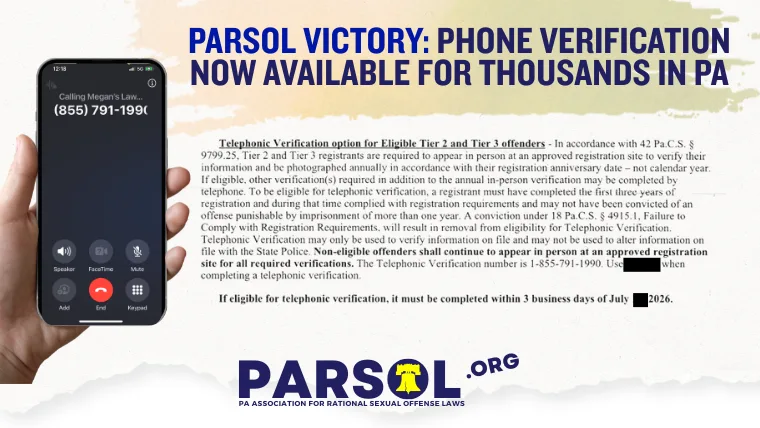
Act 10 of 2018 amended Pennsylvania’s Megan’s Law to provide individuals who had maintained three consecutive years of full registration compliance an alternative to in-person quarterly appearances: they could satisfy their remaining verification requirements by telephone, with one annual in-person appearance for identity verification and photography. The statute placed responsibility for developing and operating the system with the Pennsylvania State Police, which was required to publish notice of the system’s operational status in the Pennsylvania Bulletin before any registrant could use it.
The PSP published that notice on June 3, 2023 — five years after the law’s enactment.
Since that publication, PARSOL has documented persistent, systemic failures in the system’s administration including being told by PSP representatives that the system doesn’t work and, even, that there is no telephone registration system in existence.
PARSOL’s policy memorandum, transmitted to legislative leadership on March 11, 2026, documents this chronology in full and raises five unresolved legal questions — including whether individuals turned away from telephonic registration may have faced criminal exposure for a registration failure that was the PSP’s own.
Fiscal Accountability
PARSOL also urged the Appropriations Committee to scrutinize the public safety return on the Commonwealth’s substantial investment in registry administration.
Pennsylvania spends millions of dollars annually maintaining and enforcing its sex offense registry. That expenditure includes personnel, technology infrastructure, compliance monitoring, enforcement operations, and incarceration for technical violations. Research has consistently found no measurable reduction in rates of sexual offending attributable to public registries or notification laws. Ninety-five percent of sexual offenses are committed by individuals with no prior conviction who would not appear on any registry.
PARSOL emphasized that this is not an argument against accountability for those who commit sexual offenses. It is an argument for ensuring that public safety resources are directed toward approaches that research shows actually work — including prevention education, evidence-based treatment, and law enforcement capacity focused on new offenses – rather than systems that studies consistently show fail to reduce sexual violence.
PARSOL is urging the Pennsylvania General Assembly to take the following actions in connection with the PSP’s budget request:
- Require a full accounting of the telephonic registration system’s operational status before approving new PSP program funding – including documentation of procedures, staff training, and statewide consistency of administration.
- Direct the PSP to update all registrant communications to include telephonic registration information, eligibility criteria, and the designated telephone number, as required by statute.
- Commission a cost-benefit analysis of Pennsylvania’s sex offense registry administration, including an assessment of whether current expenditures are producing measurable improvements in public safety outcomes.
- Conduct further oversight hearings on PSP’s implementation of existing statutory mandates before authorizing expansion of new programs or administrative authorities.
“If any other Commonwealth program consumed this level of resources without evidence of effectiveness, the Appropriations Committee would demand answers,” said PARSOL Managing Director John Dawe (Dallas, PA). “The registry deserves the same standard of fiscal accountability. We are calling on the legislature to ask PSP not just whether the telephonic system is working, but whether the overall investment in registry administration is delivering the public safety returns that taxpayers deserve. Survivors of sexual harm deserve programs that actually work, not just sound good on paper.”
###
The Pennsylvania Association for Rational Sexual Offense Laws (PARSOL) is a nonprofit advocacy organization and NARSOL state affiliate. PARSOL advocates for evidence-based, constitutionally sound sex offense policy in Pennsylvania, including reforms to registration and notification laws that research shows fail to improve public safety. Learn more at parsol.org.